
Where does Damascus steel comes from?
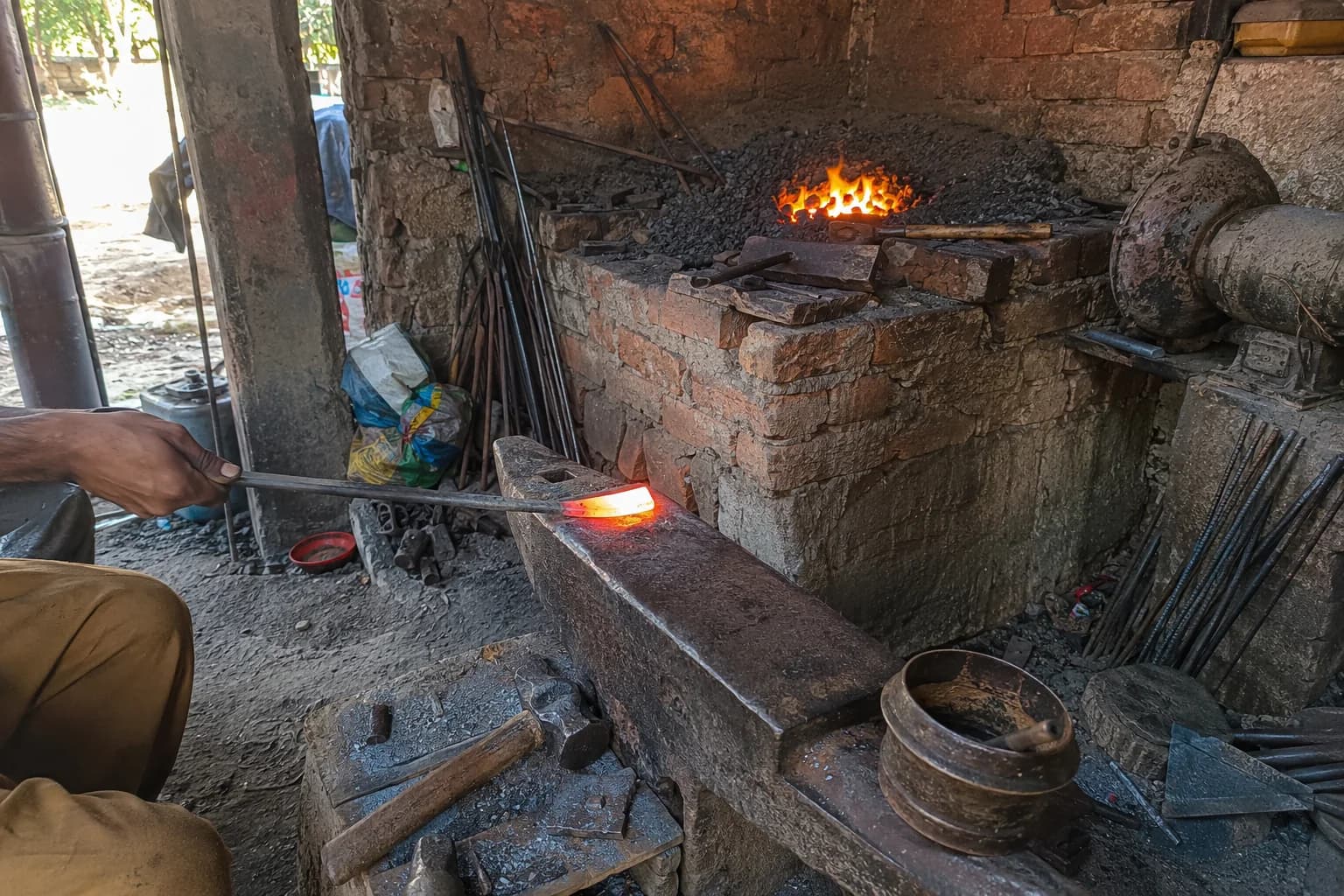
Damascus steel comes from a process, not a place. No knife sold as Damascus today is made from steel mined, smelted or forged in the Syrian city it takes its name from — the name outlived the trade route that carried it. What you are buying is pattern-welded steel: two steels forge-welded into one billet, folded and drawn out, then etched in acid so the layers show. The city gave the word. A forge gives the steel.
We forge Damascus by hand, so this is written from the bench rather than off a history page.
DOES DAMASCUS STEEL ACTUALLY COME FROM DAMASCUS?
Not in any sense that survives a close look. Damascus was a trading city, and the blades that earned the reputation were carried through it far more often than they were born in it. Europe met the steel through that trade, named it after the place it had seen it, and the word stuck long after the trade stopped.
Three explanations of the name circulate, and none of them is settled:
- The city itself — blades bought, sold or finished in Damascus, named for the market rather than the maker.
- A derivation from Arabic, usually glossed as watered, after the way the old surfaces look like moving water. This is the version repeated most often and the one philologists argue about most: the root it is supposed to come from does not hold up, and it should be read as a claim rather than a definition.
- A smith's name, absorbed into the language the way makers' names sometimes are.
For a buyer, the useful part is that not one of the three describes how the steel was made. Damascus has never been a specification. It was a reputation attached to a look, and that is still all it is.
WHAT WAS THE ORIGINAL DAMASCUS STEEL, AND WHERE WAS IT MADE?
The steel behind the legend is wootz, and it came from South Asia — southern India and Sri Lanka — where it was being made long before Europe had a word for it. It travelled west as cakes of raw ingot and was forged into blades at the far end of the route. The steel, the blades and the name all come from different places.
Wootz was one steel, not two. Iron and a carbon source were sealed into a clay crucible and held at heat until the carbon dissolved evenly through the melt. As the ingot cooled slowly, carbides gathered into bands, and forging stretched those bands along the blade. The watery figure was the ingot's own chemistry pulled into lines — nothing was stacked, folded or welded to put it there, and that is where most explanations go wrong.
IS MODERN DAMASCUS THE SAME STEEL?
No. Two different techniques share one name, and neither is descended from the other.
The wootz tradition faded through the eighteenth and nineteenth centuries. The usual account is that the particular ores and the crucible practice that made it work went out of use together, and once that chain broke there was nobody left who could repeat it from memory.
Pattern welding is the other tradition, and it has a break of its own in the middle. European smiths forge-welded rods and strips of different iron and steel into a single bar for centuries, largely because the iron they could get was inconsistent and welding it up averaged out the good and the bad. Once cheap homogeneous steel arrived that reason disappeared, and the technique largely lapsed. What put it back in workshops was a twentieth-century revival, taken up for the look rather than out of necessity — and that revival, not an unbroken line, is where every Damascus knife on sale today comes from.
A page that tells you modern Damascus descends from wootz has the relationship wrong. It borrowed the name, not the method.
WHERE DOES THE STEEL IN A DAMASCUS KNIFE COME FROM TODAY?
From a mill. That is the plain answer, and there is no romance in it. A modern billet is built from ordinary commercial bar stock, cut clean and stacked. Two steels are chosen for how they behave in acid — one darkens, the other resists and stays bright — and that difference is the only reason the pattern reads. Fold a single steel as often as you like and etch it and you will raise faint weld lines, but with no second steel to resist the acid there is no contrast, and the blade comes out grey.
What varies from one Damascus knife to the next is not the ore. It is what the hand does to the stack. The order the steels go in, how far the billet is drawn, whether it is twisted, pressed, cut into a ladder and flattened again, or drilled and forged back level — those decisions are the pattern. Two billets off the same bar, worked by the same smith on the same day, come out different.
It is forged by hand in workshops all over the world and also turned out in quantity by machine. Neither the price nor the country on the box tells you which you are holding.
HOW DO YOU TELL FORGED DAMASCUS FROM A PRINTED PATTERN?
This is where money gets lost. A convincing Damascus pattern can be put onto a plain blade with a mask and an acid bath, or with a laser, in a fraction of the time forge-welding takes. In a photograph the two are close to indistinguishable. In the hand they are not, because a forged pattern is structural — the layers physically run through the blade — while a printed one is a picture lying on the surface.
Check these, roughly in this order:
- Follow the pattern down onto the bevel. Grinding cuts through the stack at a shallow angle, so on a forged blade the pattern stretches and tightens as it nears the edge. A printed pattern was applied to a finished flat: it either stops dead at the grind line or carries across it unchanged.
- Look at the spine and the plunge line, where you are seeing the layer stack edge-on. Print rarely wraps around an edge convincingly.
- Look for exact repeats. Forge-welded patterns wander. A pattern that tiles, that shows a seam where it starts over, or that is identical across two knives in the same listing, came off a machine.
- Turn it in raking light. One steel is eaten by the acid more than the other, so an etched forged surface often carries faint relief you can catch with a fingernail. Supporting evidence only — a blade polished back after etching can be dead flat and entirely genuine.
- Read the words in the listing. Pattern-welded, forge-welded and layered describe construction. Damascus pattern, Damascus style and Damascus finish describe an appearance, and sellers choose those phrases carefully.
- Ask what a regrind would do. A forged pattern survives being sanded off and comes back with another etch, because it is still in the steel. A printed one leaves with the surface and never returns.
None of these settles it alone; together they settle it in about a minute. An etched pattern is not automatically a swindle — a knife honestly described as having a Damascus-style finish is what it says it is. The swindle is that finish sold at forged prices.
DOES THE PATTERN MAKE THE KNIFE CUT BETTER?
No, and that claim is worth killing off. The pattern is a record of how the blade was built, not a feature that cuts. Sharpness comes from geometry and the grind. Holding an edge comes from the steel and the heat treatment. A heavily layered blade is not sharper than a plain one; it only tells you more about how it was made.
What Damascus gives you is real enough: two steels welded through the full thickness of the blade, and a surface no other blade will repeat. For plenty of people that is the whole reason to buy one, and it is good enough on its own.
D2 is the answer for the other kind of buyer. It is a high-carbon, high-chromium tool steel with a reputation for edge retention — it will hold a working edge through a long day and ask for more patience when you finally sit down to sharpen it. It takes a plainer finish, and that is rather the point. A D2 knife is bought as a tool, not as an object.
Either way, Damascus is high-carbon steel and it will spot if it is put away wet. Dry the blade, wipe a little oil down it, and do not leave it in the sheath for months. Leather holds moisture against steel.
WHERE OUR DAMASCUS COMES FROM
RAVEMORN is a hand-forging workshop. Every billet is stacked, welded, folded and drawn by hand, in small numbers, which is why the patterns vary from one piece to the next instead of repeating down a production run. We make fixed blades and folders in Damascus, and a D2 line for people who want the tool without the figure. Handles run to stabilised laminate, resin, stag and bone, and hardwood, with brass bolsters and fittings, and leather sheaths.
- Hunting knives — forged fixed blades for field work
- D2 steel — plain tools bought for edge retention
- Folding knives — pocket and EDC folders
- Best sellers — the pieces that leave most often
- Browse the full catalogue