
The Unsuspected Origins of Damascus Steel
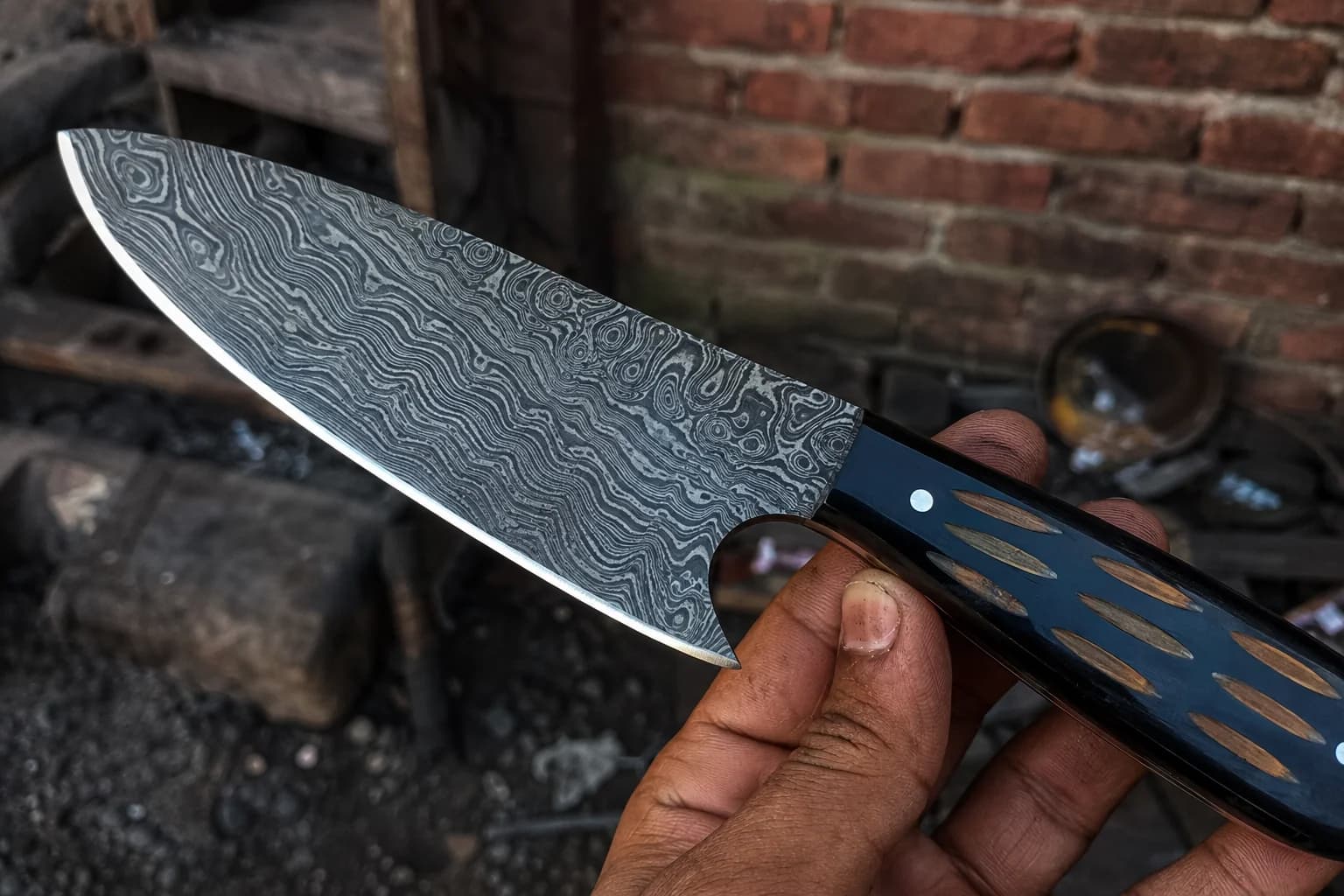
Damascus steel did not come from Damascus. It came from wootz — a crucible steel smelted in southern India and Sri Lanka, cast into small ingots, and traded west through Persia and Syria to smiths who forged it into blades carrying a fine watery pattern. The city was a market and a forging centre on that route, and it is where Europeans met the finished swords, so the name stuck to the steel. That much the record supports. Almost everything after it — who coined the name, what it first meant, and how the technique stopped — is still argued over.
We forge pattern-welded Damascus by hand, so we have an interest in getting the distinction right. The steel we make is not the steel in the histories: the same name, almost none of the same process. What follows is what is reasonably established, what is contested, and where the honest answer is that nobody knows.
WHERE DID DAMASCUS STEEL ACTUALLY COME FROM?
Smelters in southern India and Sri Lanka ran a crucible process that produced small cakes of high-carbon steel, and those cakes were a trade good in their own right — carried west and forged into finished blades, mostly by Persian and Arab smiths, a long way from where the metal was born. The reputation travelled with the blades rather than with the ingots.
The blades reached Europe through the eastern Mediterranean, and European accounts are where most of the legend comes from — the sword that parts a silk scarf dropped across its edge, the blade that cuts a lesser sword in half without notching. Those are stories about reputation, not evidence about metallurgy, written by people describing a weapon they could not make — the condition that reliably produces legends.
WHAT WAS WOOTZ, AND HOW WAS IT MADE?
Wootz was crucible steel. Iron and a carbon-bearing charge — charcoal, wood, leaves — were sealed in a clay crucible and held at high heat for hours until the contents melted and the carbon went into solution. The crucible was then cooled slowly. What came out was a small high-carbon ingot far more even throughout than a bloomery could manage, with the carbon controlled rather than left to chance.
The slow cooling is the part that matters for the pattern. As the ingot cooled, carbides came out of solution and gathered into bands inside the metal. Forging stretched and aligned those bands, and a light acid etch lifted them to the surface as the watery figure the blades are known for. The pattern was already in the steel. Forging revealed it and steered it.
That also made the metal unforgiving. Take it too hot and the banding dissolves back into solution and does not come back, so the smith worked in a narrow window with no second attempt. Recipes varied between workshops and were held by families rather than written down in a form another smith could follow.
WHY IS IT CALLED DAMASCUS STEEL IF IT WAS NOT MADE THERE?
Nobody has settled this, and the tidy answer you usually get is a guess wearing a straight face. Four explanations are in circulation and each has serious people behind it.
- The city itself. Damascus was a trading and forging hub on the route the ingots travelled, and it is where European buyers encountered the finished blades. Naming a good thing after the place you bought it is ordinary behaviour.
- The Arabic root for water. The surface figure is called watered in several languages, and the steel is still known as watered steel in some of them. This derivation is the most repeated of the four and the one philologists dispute most.
- Damask, the figured cloth. The same root describes woven fabric with a pattern that shifts as the light moves across it, which is a fair description of an etched wootz blade.
- A smith, or a named grade of sword. Early accounts refer to particular makers and grades of blade, and a name of that kind can outlive the man and harden into a category.
Any article that states one of these flatly is choosing a side without telling you. The name arrived long before anybody was in the habit of recording where names came from.
WOOTZ WAS NOT PATTERN-WELDED, AND THAT IS WHERE MOST ARTICLES GO WRONG
This is the error worth fixing, and the page this one replaces made it. It told the wootz story and then, a paragraph later, defined Damascus steel as layers of two metals hammered together at heat. Those are two materials made two different ways, and running them together turns the history into nonsense — because if Damascus had meant pattern welding, nothing about it could ever have been lost.
- Crucible Damascus is one steel. A single homogeneous high-carbon ingot, in which the pattern is carbide banding inside the metal, brought out by careful forging and an etch. Nothing is stacked, folded or welded to anything.
- Pattern-welded Damascus is two steels or more. Different steels are stacked, forge-welded into one solid billet, then folded and drawn out again. The pattern is the boundary between the layers, and it shows because the two steels darken at different rates in acid. This is what every modern Damascus knife is, ours included.
The popular story gets a second thing backwards. Pattern welding is not a modern imitation of wootz — it is a tradition that arrived at a patterned surface by its own route. Celtic, Roman and Norse smiths welded strips of iron and steel together partly because no single piece they could produce was dependable alone, and welding averaged out the weak spots. But the figure was not an accident they merely tolerated: in migration-era and Merovingian blades the twisted, re-stacked rod arrangements are held to have been chosen for how they would look. The decoration was deliberate. When homogeneous steel became cheap and reliable the practical reason fell away, and the decorative one carried the technique forward.
So modern Damascus is not the revival of a lost Indian process. It is a different craft that inherited the name.
HOW WAS THE TECHNIQUE LOST?
The usual line is that the method vanished in the 1700s. Closer to the truth: production wound down across a long stretch, blades of the old quality stopped appearing, and the reasons are still contested. Three explanations get taken seriously, and none rules out the others.
- The ore. The particular deposits used may have carried trace elements the process quietly depended on, and those sources were worked out. A steel that needs an impurity nobody knew was there is a steel that dies when the mine does.
- The knowledge. It lived in hands, not in books. Tacit skill held inside a workshop disappears within a generation once the work stops, and there was nothing written down that could rebuild it.
- The trade. Demand, routes and the organisation of iron making in the region all changed. Remove the market and the makers stop, whether or not they still know how.
Researchers have since produced steels that reproduce parts of the effect. Whether any of it is the same steel has no agreed answer, partly because there is no agreed definition of what would count as the same. Anyone offering you a rediscovered ancient recipe is making a marketing claim, not a metallurgical one.
WHAT IS MODERN DAMASCUS STEEL, THEN?
Modern Damascus is the pattern-welded kind — stacked, brought to welding heat, drawn out, cut, folded and welded again. The figure is directed by what the smith does to that billet between welds: twisting it, pressing it, cutting and restacking it before the final draw. An acid etch finishes the job, darkening one steel and leaving the other bright. No two billets come out the same, which is not a slogan but what happens when the work is done by hand at welding heat.
It is worth saying plainly that pattern welding does not make a blade sharper or tougher than the steels that went into it. It is those steels, joined. What the process gives you is the figure and a record of how the piece was made. If you want a knife bought purely as a tool, D2 is the honest answer — a high-carbon, high-chromium tool steel with a reputation for holding a working edge, plainer to look at and slower work to sharpen. Damascus and D2 answer different questions, and neither one is the upgrade.
WHAT THE HISTORY SHOULD CHANGE ABOUT HOW YOU BUY
- Judge the pattern by depth, not by picture. A forged pattern runs through the thickness of the blade, so it survives being reground. Surface etching and printed imitations do not.
- Expect variation, and treat matched pieces with suspicion. Consistency across a whole range is the signature of a production line, not of a forge.
- Ignore layer counts. A layer number is a marketing figure. Weld quality, heat treatment and geometry decide whether a knife works.
- Dry it and oil it. High-carbon steels spot if they are put away wet, and Damascus is a high-carbon steel with a decorative surface that shows every mark.
- Buy the shape for the job first. History is a good reason to want Damascus and a poor reason to accept the wrong blade in it.
RAVEMORN is a hand-forging workshop. Knives are made by hand in small numbers, which is why patterns and handle materials vary from one piece to the next instead of repeating down a run — fixed blades and folders, laminate, resin, stag, bone and hardwood handles, brass bolsters, fitted leather sheaths.
- Hunting knives — fixed blades for skinning, dressing and butchering
- D2 steel — plainer knives bought for edge retention
- Folding knives — pocket and EDC folders
- Best sellers — the pieces that leave the workshop most often
- Browse the full catalogue