
What is a Damascus Knife?
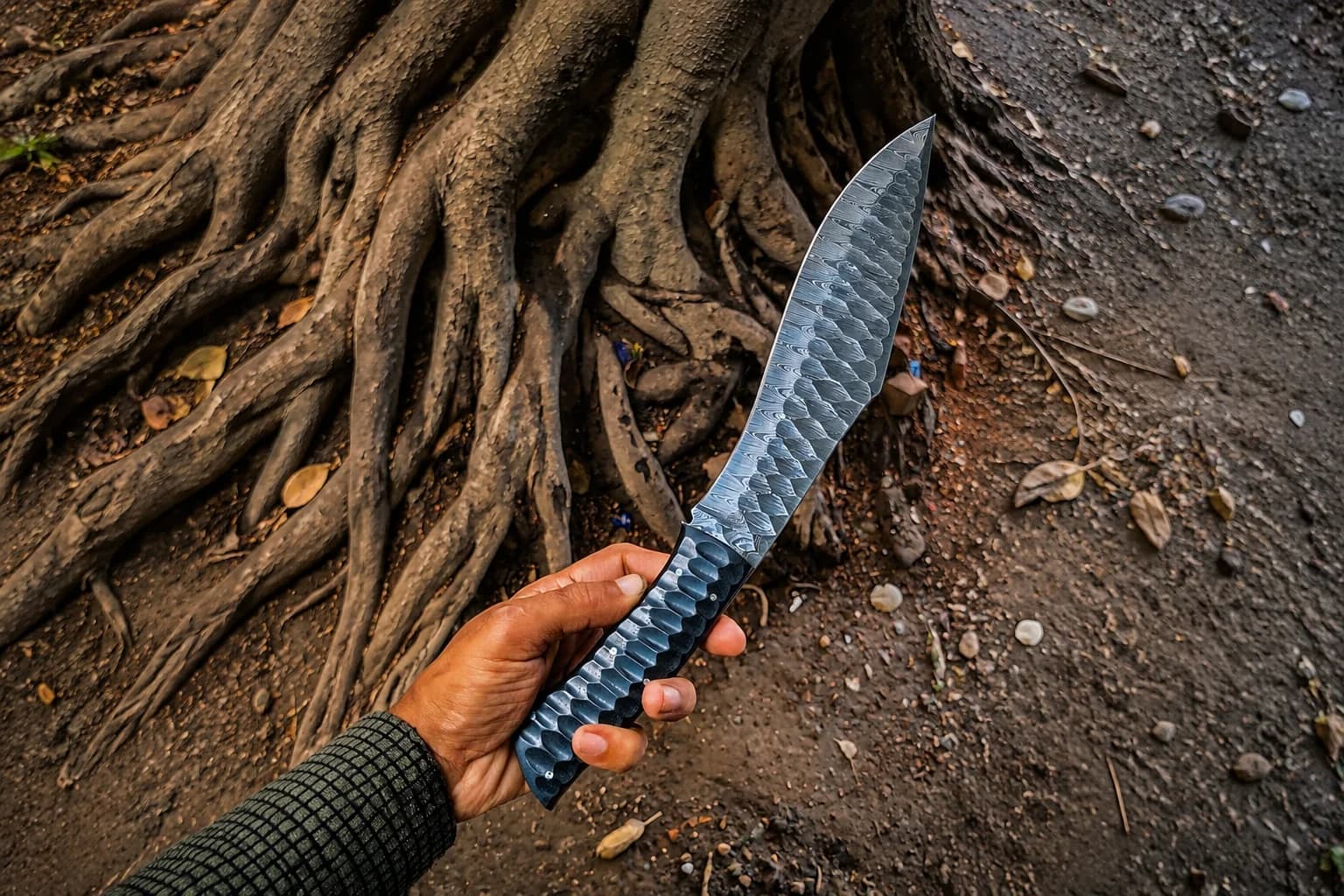
A Damascus knife is a knife with a pattern-welded blade: two different steels forge-welded into one bar, folded and drawn out, then etched in acid so one steel darkens, the other stays bright, and the layering surfaces as a flowing pattern. The pattern is the definition. It is not a grade of steel, not a place of origin and not a claim about age: a blade is Damascus because of how the bar was built.
We forge these by hand, so this is written from the bench.
HOW IS A DAMASCUS BLADE ACTUALLY MADE?
It starts as a stack. Flat bars of two steels are cleaned, alternated and clamped into a billet, brought to welding heat, fluxed and struck — the hammer drives the flux out from between the layers and the two steels become one piece of metal. That is the forge weld, and it is the part that goes wrong: a weld that does not take leaves a cold shut, a hairline seam of nothing inside the bar, and a blade with one in it is scrap.
The bar is then drawn out, cut, folded back on itself and welded again, each pass doubling the layers and halving their thickness until they read as grain rather than stripes. Left flat that gives straight lines — honest, and dull. The patterns people buy Damascus for come from disturbing the stack before grinding: twisting the bar, pressing dies into it, or drilling into the surface. The grind then cuts across the layers at an angle rather than along them, exposing them as loops, ladders and waves.
The acid comes last; before it, every layer is already there and the blade looks like plain grey steel. No two billets come out alike, because the pattern depends on how that bar moved under that hammer.
DOES FOLDING THE STEEL REMOVE IMPURITIES OR ADD STRENGTH?
No. It is the most repeated claim about Damascus knives, and it is a true statement about a different steel in a different century.
Folding out impurities describes steel that came from the fire full of slag, where there was something to fold out. Modern steel arrives from the mill clean and uniform. Fold a clean steel a dozen times and you have a clean steel with more layers in it.
Nor does folding add strength. A forge weld is at best as strong as the steel either side of it, and never stronger. Every weld is a place where the blade could fail and happens not to — a success, not an improvement. Layer count is a decision about the scale of the pattern, not a specification of quality. Edge retention and toughness come from which steels went into the stack and what the heat treatment did to them.
So why fold at all? For the pattern — folding is how you get enough layers for it to read as flow rather than as a sandwich — and for the pairing: one steel to take and hold a hard edge, the other for toughness and for the way it resists the acid and stays bright against the dark.
WHY IS A MODERN BLADE STILL CALLED DAMASCUS?
Because the look was named long before this method existed. The original Damascus steel was wootz, a crucible steel made in South Asia and traded west. How the name attached to it is disputed — the trading city, the Arabic word for watered silk, and the name of a smith have all been argued for, and none of it is settled. What is clearer is that the steel itself was not smelted there: blades were forged in Damascus, but from ingots that arrived from elsewhere.
Wootz was not folded and it was not two steels. It was melted in a sealed crucible and cooled slowly into an ingot; its watery surface came from bands of carbide that the slow cool and the later forging drew out of a single steel, brought up at the end by etching and polishing. Those blades earned their reputation for holding an edge and for not snapping, and that reputation belongs to the crucible, not to a hammer folding layers. The wootz trade died out and took its method with it; every Damascus knife sold today, ours included, is pattern-welded.
HOW DO YOU TELL REAL DAMASCUS FROM A PRINTED PATTERN?
Throw away the most common test first. Buying guides — including the version of this page we replaced — say acid etching is the mark of a fake. It is the exact opposite: etching is how a pattern-welded blade is revealed, and without it a real Damascus blade looks like plain steel. The question is whether the pattern goes through the metal or sits on top of it.
- Follow it off the flat. On a forged blade the pattern carries over the spine, down the bevel and into the tang, because it is the whole bar. A printed or laser-marked one stops at the first change of surface.
- Watch it change with the grind. Where the bevel cuts deeper the lines shift and open out, because a different depth of the stack is exposed. A print keeps identical lines over a changing surface.
- Turn it in raking light. The acid eats one steel faster than the other, so a real surface carries a faint relief a fingernail catches. A print is dead flat.
- Distrust perfect repetition. Real twists and ladders wander and interrupt themselves, and two hand-forged billets never match; flawless symmetry down a blade, or an identical pattern across a whole run, is a printer's habit rather than a hammer's.
Two inherited tests worth dropping. Do not flex the blade to see whether it springs back — a hardened blade is not a spring, and bending one tells you where it breaks. And price proves nothing; it is set by a market, not by the metal.
IS A DAMASCUS KNIFE BETTER THAN A D2 KNIFE?
Neither is better. They answer different questions, which is why we forge both. D2 is a high-carbon, high-chromium tool steel known for edge retention: it holds a working edge through a long day and asks for more patience at the stone, because the hardness that keeps the edge is the hardness that resists restoring it. It takes a plainer finish, and that is rather the point — a D2 knife is bought as a tool. Damascus is chosen for the pattern and the pairing, a working knife that is also an object.
The difference in the hand is smaller than the internet suggests. Both are high-carbon steels, both sharpen on the same stones, and both will spot if put away wet. The chromium in D2 resists staining a little better, but it is a tool steel and not a stainless one. Buy on the job: hard use and frequent resharpening point to D2; wanting the knife looked at as well as used points to Damascus.
WHAT IS A DAMASCUS KNIFE USED FOR?
Whatever its shape is for. Most writing on this steel has it backwards, describing the metal and then listing uses as though the pattern decided them. The pattern tells you how the bar was built; shape, grind and heat treatment decide what the blade can do. A Damascus skinner and a Damascus kitchen knife share a look and nothing else.
In practice it turns up in four places: hunting, where a full-tang fixed blade with a deep belly does the skinning and butchering; camp use, where a thick spine matters more than a fine tip; everyday carry, a folder's job; and the kitchen, where a slicing blade is bought partly for the board it sits on.
One warning, because the copy this page replaces promised the opposite. A Damascus knife is not unbreakable and it is not a pry bar. Twist one in a joint and you will find the limit of any steel, folded or otherwise.
HOW DO YOU LOOK AFTER A DAMASCUS BLADE?
Treat it as high-carbon steel wearing a finish that can be worn off. The etch is a surface: it fades under heavy polishing and darkens with years of use. Neither is damage.
- Wipe it dry the moment you finish. Blood, fruit acid, salt and plain water mark carbon steel, and they start on contact.
- Wash by hand — a dishwasher will spot the blade, cook the handle and flatten the pattern.
- Oil the blade before it goes away: food-safe oil for a kitchen knife, light machine oil for a field knife.
- Sharpen on a stone at the angle the edge came with. This does not ruin the pattern; it exposes fresh steel on the bevel, which darkens again with use.
- Do not leave it in its sheath for months. Leather holds moisture against steel; a sheath is for carrying, not storing.
- Look after the handle. Laminate and resin need nothing; stag, bone and hardwood want drying after a wet day and an occasional wipe of oil.
WHAT WE FORGE
RAVEMORN is a hand-forging workshop. Every knife is made by hand in small numbers, which is why patterns and handle materials vary from piece to piece rather than repeating down a production run. We forge fixed blades and folders, in Damascus and in D2, with handles in stabilised laminate, resin, stag and bone and hardwood, brass fittings, and fitted leather sheaths.
- Hunting knives — Damascus fixed blades for skinning and field dressing
- D2 steel — plainer blades bought for edge retention
- Folding knives — pocket and EDC folders
- Best sellers — the patterns that leave the workshop most often
- Browse the full catalogue