
What Is A Fixed Blade Knife? Everything You Need To Know
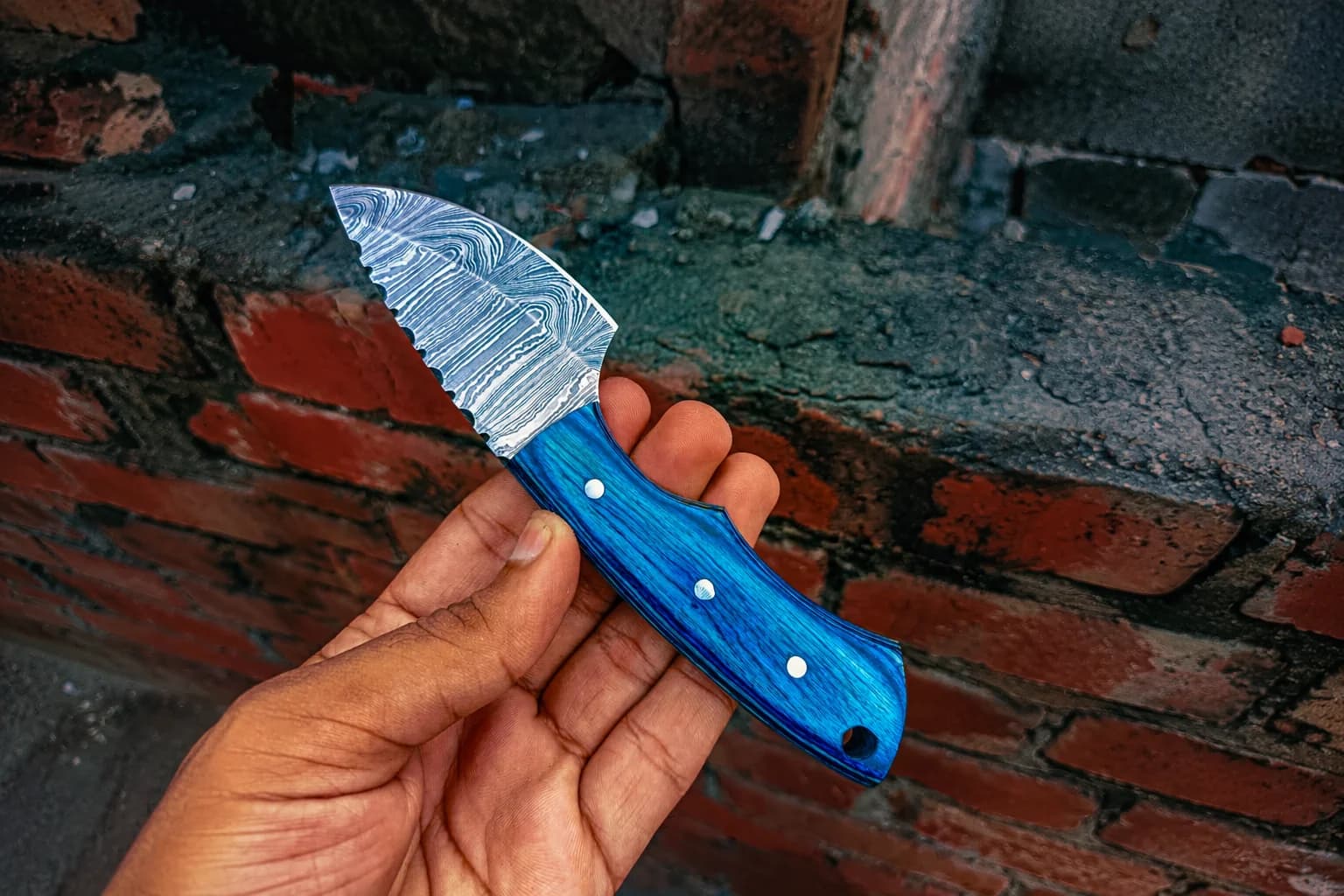
A fixed blade knife is a knife whose blade does not fold: the blade and the tang are one continuous piece of steel, and the handle is built around that steel rather than hinged to it. There is no pivot and no lock, which is why it is the standard pattern for hunting, butchering and camp work. What a fixed blade is not, automatically, is stronger than a folder. How far that steel runs back into the handle decides that, and tangs differ enormously.
We forge these by hand, so this is written from the bench: what a fixed blade is, why full tang against partial tang is the decision this question is really about, and where the usual advice overstates the case.
WHAT IS A FIXED BLADE KNIFE MADE OF?
Four parts. The blade, everything forward of the handle. The tang, the same bar of steel continuing backwards. The handle, either two scales pinned to that tang or a one-piece grip slid over it. And the sheath, because a knife that cannot be folded has to be covered by something else. A bolster may sit between blade and handle, adding weight behind your hand. But the defining feature is an absence rather than a presence: nothing moves. That is where most descriptions stop, and it is why most of them mislead.
WHAT IS A TANG, AND WHY DOES IT DECIDE THE KNIFE?
The tang is the part of the blade you cannot see: the steel that runs back inside the handle. It carries every load you put through the knife, and it is where fixed blades fail. Not the edge, not the spine. The handle end. A knife under load bends, and bending stress concentrates wherever the cross-section changes abruptly. On a knife that place is the shoulder, where the full-width blade steps down into the tang. Make that step sharp and small and you have built a hinge that only moves once.
FULL TANG
A full tang has the same outline as the handle: the steel runs the full length and depth of the grip, with a scale pinned or riveted to each side. You can see it: a continuous line of steel along the top of the handle, along the bottom and across the butt. There is no step down and no joint, so a load applied at the tip is carried by the whole handle instead of by a narrow neck. That is why full tang is the sensible default on a working knife.
PARTIAL, HIDDEN AND RAT-TAIL TANGS
Everything else is a version of narrower. A hidden or stick tang is a slimmer tongue of steel buried in a slot in a one-piece handle, usually glued and often drawn tight by a threaded nut at the pommel. A rat-tail tang is thinner again, round or square in section. A partial or stub tang stops part-way down the handle and leaves the rest hollow.
None of these is automatically bad. A well-made hidden tang, forged from the same bar as the blade, buys a lighter knife and the freedom to use a shaped block that cannot be slabbed. What to refuse is a tang welded onto the blade rather than forged from it, and any stub tang on a knife you mean to work. Lever a stub-tang knife sideways against a bone and the load lands on the last inch of steel and the glue around it. The blade does not snap in the middle. It comes out of the handle.
HOW DO YOU TELL A FULL TANG FROM A PARTIAL ONE BEFORE YOU BUY?
- Look along the top and bottom edges of the handle. A full tang shows a continuous strip of steel between the scales; a hidden tang shows unbroken handle material.
- Look at the butt. Exposed steel is a good sign; a decorative cap or a single nut usually means something narrow underneath.
- Count the fasteners. Two or three pins through the handle say scales on a tang; one threaded pommel says stick tang.
- Feel the balance. A full tang carries weight back into your palm; a stub tang feels blade-heavy and oddly light.
- Ask. A maker who forges the tang from the same bar as the blade will say so without hesitating.
IS A FIXED BLADE ALWAYS STRONGER THAN A FOLDING KNIFE?
No, and this is the claim worth correcting, because it is repeated everywhere, including on the page this one replaces. The argument runs that a fixed blade is stronger because it has no moving parts. It sounds obvious, and it points at the wrong part of the knife.
It assumes the pivot is the weak point in every comparison. A folding knife's lock is loaded in one direction, resisting the blade closing on your fingers, and a well-made lock takes that load competently. The fixed blade's weak point is buried inside the handle where you cannot inspect it, and it is entirely a function of how much steel the maker put there. A stout full-tang fixed blade beats any folder comfortably. A thin welded rat-tail loses to a well-built folder. The words fixed blade tell you nothing about strength on their own. The tang does.
What the absence of a pivot genuinely buys is something else, and still worth having.
- Nothing to loosen. A pivot works loose over years of use; a pinned tang does not.
- Nothing to clean around. Blood, hair, fat and grit pack into a pivot and stay there; a fixed blade washes off in one pass, which matters when what you are cleaning off it is food.
- No lock between your hand and the edge. A lock is a mechanism, and mechanisms fail. Nothing on a fixed blade can fail closed.
- It is ready. No two-handed opening while your other hand holds a carcass.
So a fixed blade is more reliable than a folder by construction. Whether it is stronger depends on the tang, and reliability and strength are not the same claim.
WHAT IS A FIXED BLADE KNIFE USED FOR?
Field work, mostly: dressing and skinning game, breaking a carcass down into cuts, and the camp jobs around that — cordage, stakes, kindling, food at the tailgate. The list of things a fixed blade should not be asked to do is shorter and more useful.
- Prying or turning screws — lids, staples, nailed crates, tins. A blade has very little strength across its width, and the tip is the thinnest, least supported part of it.
- Chopping into anything that will shock the edge. Bone at the joint is fine; swinging into a bone shaft or frozen wood is not. Not because those things are harder than hardened steel, because they are not, but because a hardened edge is thin and brittle and a sudden impact chips it. Buried grit is different again: it abrades the edge as it drags through the cut.
- Throwing. A way of finding out whether the tang is any good, in the worst possible manner.
The page this one replaces suggested opening cans and bottles with a fixed blade, on the grounds that the blade is held tightly enough to take it. Do not: that is a prying load at the tip, and the most common way a good knife becomes a broken one.
FIXED BLADE OR FOLDING KNIFE: WHICH SHOULD YOU CARRY?
The honest trade is carry, not danger. A fixed blade cannot be made smaller, so it rides in a sheath on a belt and takes up room; a folder closes into its own handle and goes in a pocket. That is why people who own both tend to carry the folder daily and reach for the fixed blade when there is work.
The sheath is part of that decision: one that holds the knife when you bend over is worth more than another inch of blade. Carry law also varies by jurisdiction, so check the rule where you are before settling on a length.
DOES DAMASCUS OR D2 CHANGE HOW A FIXED BLADE PERFORMS?
Not the way the tang does, but both change how the knife is lived with. Damascus is pattern-welded: two steels forge-welded into a billet, folded and drawn, then etched so the layers show. No two billets come out the same. D2 is a high-carbon, high-chromium tool steel that holds a working edge through a long day and asks for more patience to sharpen. A D2 fixed blade is bought as a tool; a Damascus one as a tool that is also worth looking at.
Handle material matters as much: laminate and resin shrug off blood and rain, while stag, bone and hardwood want drying and oiling after a wet day. Care is short. Dry the blade and leave a film of oil on it before it goes away, because high-carbon steels, Damascus included, will spot if they are stored wet. Keep the edge sharp: a dull blade needs force, and force is what slips.
WHAT WE FORGE
RAVEMORN is a hand-forging workshop. Knives are made by hand in small numbers, which is why the Damascus patterns and the handle materials change from one piece to the next instead of repeating down a production run. Fixed blades are the core of it, and most leave with a fitted leather sheath.
- Hunting knives — full-tang fixed blades for skinning and dressing
- D2 steel — plain fixed blades bought for edge retention
- Folding knives — pocket and EDC folders
- Best sellers — the fixed blades that leave most often
- Browse the full catalogue