
This Is What A Slicing Knife Is Used For
A slicing knife is used to cut cooked, boneless meat into clean even slices — brisket, ham, roast beef, turkey breast, smoked salmon. It is a long, narrow, thin blade, usually eight to fourteen inches, with almost no curve to the edge and often a rounded tip, and every one of those choices exists so you can take a slice off in one unbroken stroke instead of sawing.
Sawing is the problem the knife was built to solve. Every time the blade changes direction mid-cut it tears muscle fibres instead of severing them, the cut face comes out ragged, and the meat weeps juice onto the board. A blade longer than the meat is wide crosses the full width in one pass.
We forge hunting knives, not kitchen slicers, so this is written from the working end of the same problem. It also corrects the page it replaces, which sent hunters into the field with a slicer to skin game and clear brush.
WHAT IS A SLICING KNIFE?
A slicer is a single-purpose kitchen blade for portioning cooked protein. Five things define it, and none of them are decoration.
- Length. Eight to fourteen inches. The blade must be longer than the meat is wide or you will end up sawing.
- A narrow blade. Less steel sits against the cut face, so there is less drag and the slice releases. A tall blade wedges.
- A thin grind. What forces a slice apart is the shoulder behind the edge, not the edge itself, so a slicer tapers a long way back.
- A straight edge. A slicer never rocks against a board; you want as much edge as possible in contact along the pull.
- A rounded or barely pointed tip. A point does no work here, and a blunt tip will not gouge the platter.
Flex is the one real variable. A salmon slicer is flexible so it can lie almost flat and follow a fillet; a roast slicer is stiffer, because a long flexible blade wanders when dense meat pushes back.
WHAT DO YOU USE A SLICING KNIFE FOR?
Anything cooked, boneless, and wider than a shorter knife can cross in one stroke.
- Roast beef, pork loin and leg of lamb — the everyday job, one long draw across the grain.
- Brisket and smoked shoulder — about as wide as home slicing gets, and the reason fourteen-inch slicers exist.
- Turkey and goose breast, once it has come off the frame. Carving gets it off; slicing portions it.
- Cured meat, salami and cold cuts, where thin and even is the entire point.
- Smoked salmon, cut with a flexible blade held nearly flat in one long draw from the tail end.
What it is not for: bone, anything frozen, anything needing a point, and anything needing force against a board. Hand a slicer those jobs and it will flex, bind or chip.
WHAT IS THE DIFFERENCE BETWEEN A SLICING KNIFE AND A CARVING KNIFE?
They are sold as the same thing and they are not. The difference is bone. A carving knife takes meat off a carcass; a slicing knife divides meat that is already off it. That one distinction predicts every other difference between them.
IS A CARVING KNIFE THE SAME AS A SLICER?
No. A carving knife has a pointed tip, a taller stiffer blade and more belly, and commonly runs eight to ten inches. All of that is for negotiating bone: the point starts a cut in an awkward place and separates a joint, the belly follows the round of a leg, and the stiffness lets you lean against a rib without the blade wandering. A slicer is straighter, narrower, thinner behind the edge and blunt-tipped, and it should not meet bone at all. The two length ranges overlap, so inches are the weakest way to tell them apart — the tip, the belly and the stiffness are what actually separate them.
They work in sequence: the carving knife takes the breast off the bird, the slicer turns it into even slices. Carve with a slicer and you keep reaching for a tip you do not have.
CAN A CHEF'S KNIFE DO THE JOB?
Not well, and the reason matters, because the usual advice — buy a sharper knife — does not fix it. A chef's knife is a board knife: tall, curved along the belly, built to rock onto a hard surface. Put it on a brisket and it is too short, so you saw, and sawing tears fibres; it is also thick behind the edge, so it wedges the slice apart and the slice sticks to the flat. Both failures are geometry, not sharpness.
WHY DO SLICING KNIVES HAVE DIMPLES IN THE BLADE?
Those oval hollows are properly a kullenschliff — scoops ground alternately into each face just above the cutting edge. Shops and catalogues call them a granton edge, but a true Granton grind is scalloped through the full depth of the blade, which is not what sits on a dimpled slicer. The hollows do one thing: they interrupt the flat so a wet slice cannot form a continuous seal against the steel.
Here is the part usually got wrong. Hollows do not make a knife sharper and they do not help it cut. They do nothing at the edge, which is an ordinary edge below them. Less steel touches the cut face and no unbroken film of moisture forms along it, so the slice releases instead of clinging and folding over. A slice that sticks is a slice that tears when you lift it. Buy the dimples for release, not for a keener knife.
CAN YOU USE A SLICING KNIFE FOR HUNTING?
No, and the article this page replaces said otherwise in three separate places, so it is worth being blunt. A slicer is a kitchen knife: long, thin, often flexible, with no strong tip and usually no guard. It fails at every field job you might hand it.
Skinning is done with the sweep of a short deep belly, three or four inches of it, the tip riding above the hide so the edge parts skin from muscle without nicking either. A fourteen-inch straight blade has no belly to sweep with and no control over the far end of the edge against a carcass that keeps moving.
Raw deboning wants a blade narrow and stiff, five or six inches, so it can follow a seam and turn inside a joint without levering. A slicer is narrow and not stiff: load it sideways against bone and it bends rather than tracks, and a blade that bends under your hand is one you are no longer aiming.
Clearing brush is worse — a long thin blade carries no mass, and prying with one is how blades break where the blade meets the handle. Throwing a knife at an animal is not a hunting method at all; knives process game after it has been taken. The slicer's place in a hunter's year is at the table, on the cooked haunch.
HOW DO YOU SLICE MEAT WITHOUT SHREDDING IT?
The knife is half of it. The other half is technique.
- Rest the meat before it meets the blade. Cut it straight out of the heat and the juice runs onto the board instead of staying in the slice.
- Find the grain and set the blade across it. You are shortening muscle fibres; cutting along them leaves them full length, which is what makes a slice chewy. On brisket the grain changes direction partway along, so turn the meat rather than the knife.
- Start with the heel at the far side of the meat and draw the whole length back towards you in one pull. Length is the point of this knife, so use all of it.
- Use almost no downward pressure. Weight compresses the meat and squeezes juice out ahead of the edge.
- Never saw. If you are going back and forth, the blade is too short for the meat or too dull to bite, and pushing harder fixes neither.
WHICH KNIVES DO THIS JOB IN THE FIELD?
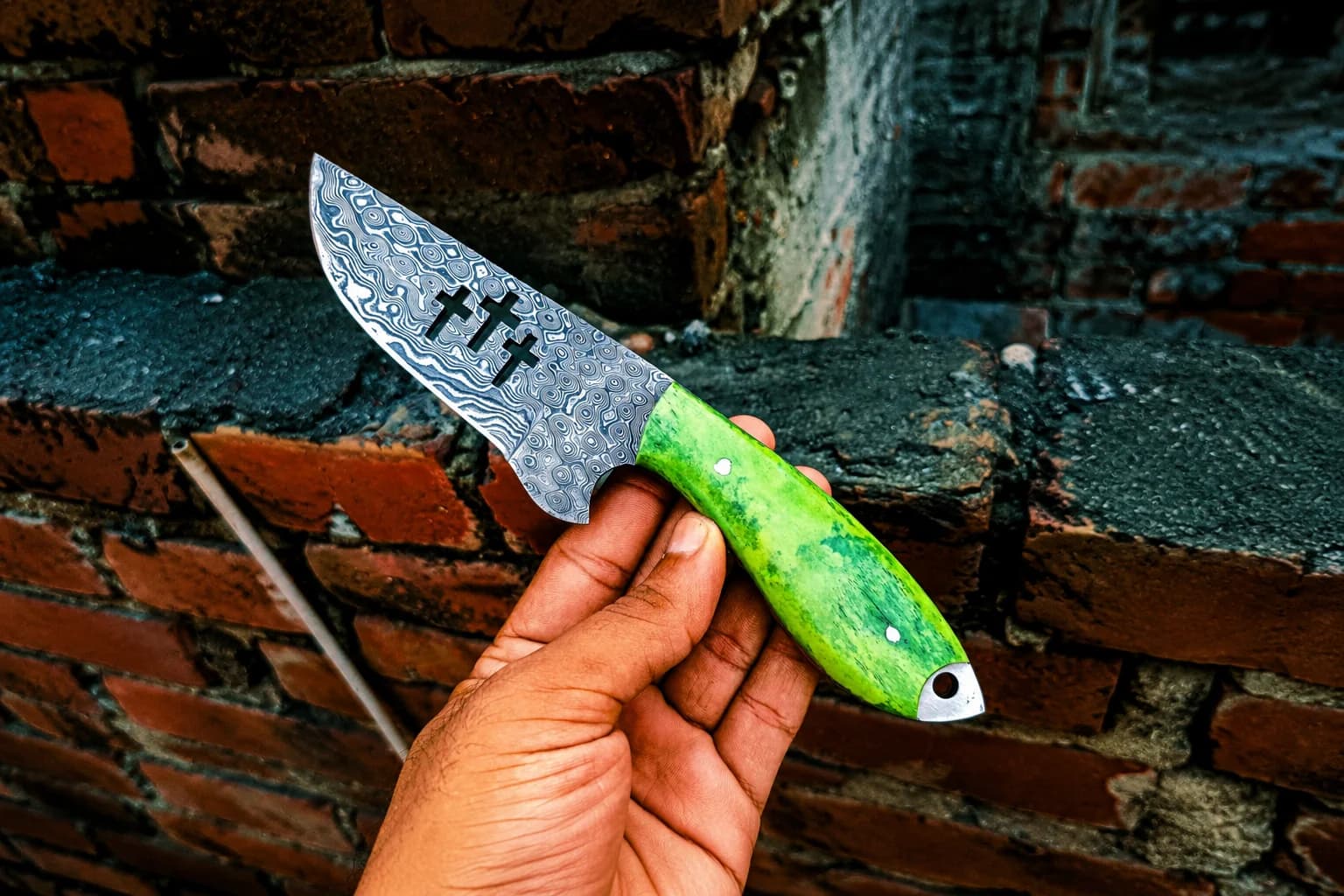
RAVEMORN is a hand-forging workshop and what we forge is hunting steel: fixed blades and folders for skinning, field dressing and butchering, and larger blades for the heavy work. We do not make kitchen slicers. What the two share is everything that happens before the handle goes on.
Damascus is pattern-welded. Layers of two steels are forge-welded together, then folded, drawn and folded again, and etched at the end so the pattern the forging left behind comes up out of the surface. No two billets come out the same, which is why no two of our knives do either.
D2 is the other steel worth understanding: a high-carbon, high-chromium tool steel known for edge retention, plainer in finish than Damascus and slower to sharpen. On a long cutting job that trade sits the right way round, because a blade that goes dull halfway through stops cutting and starts tearing.
Handles are a working choice as much as a cosmetic one: stabilised laminate and resin shrug off blood and wet, while stag, bone and hardwood are warmer in the hand. Whatever the steel, dry the blade and oil the edge before it is put away — high-carbon steels, Damascus included, will spot if they are stored wet.
- Hunting knives — fixed blades for skinning, dressing and butchering
- D2 steel — plain tools bought for edge retention
- Folding knives — pocket and EDC folders
- Best sellers — the pieces that leave the workshop most often
- Browse the full catalogue