
Types of Hunting Knives and Their Uses
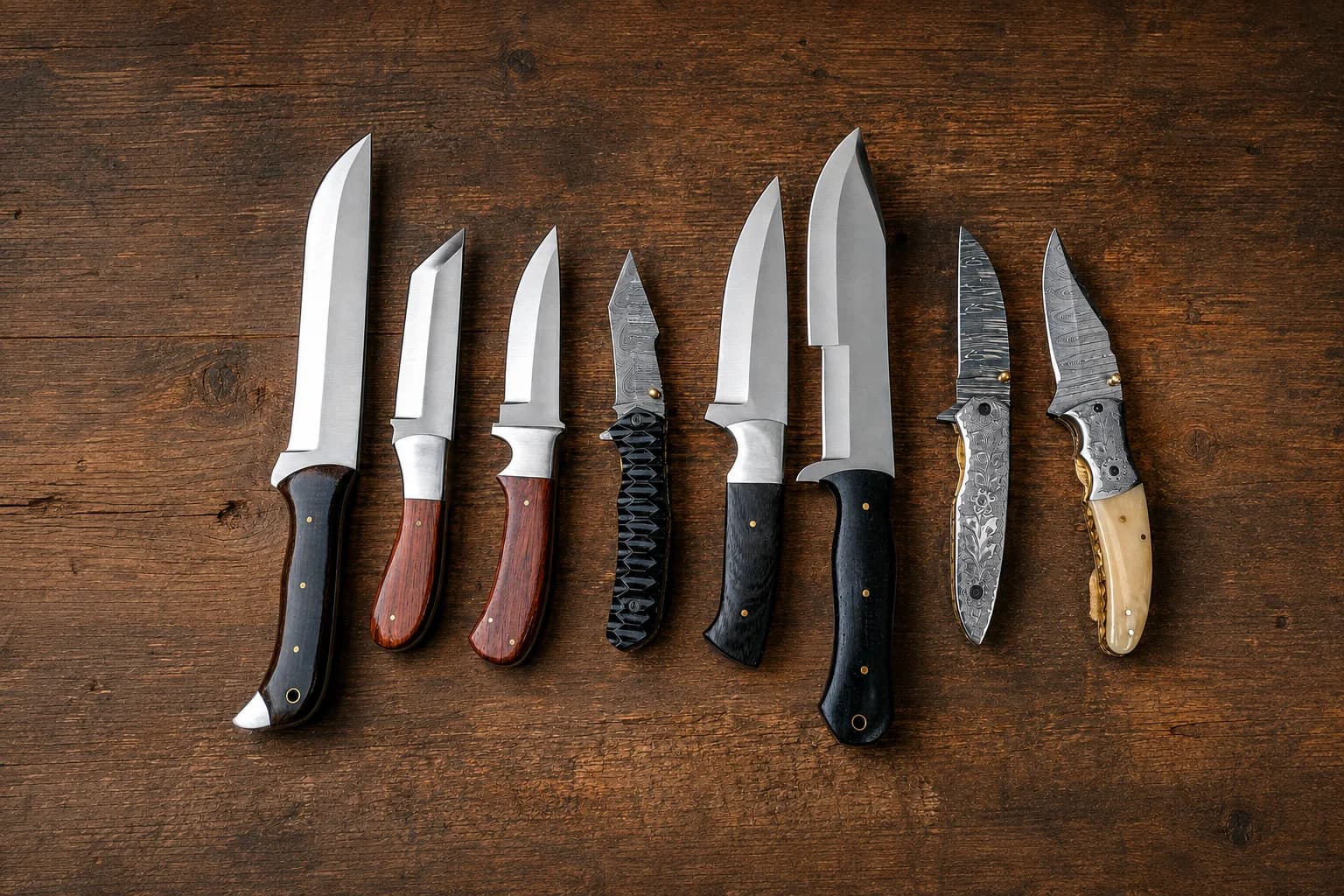
There are six hunting knives worth carrying, and each one exists because a different part of the job asks for a different edge. A skinner separates hide from muscle. A caper works around the head when the cape is going to a taxidermist. A boning knife follows the seam between meat and bone. A gut hook opens the belly without opening the paunch. A bowie takes the heavy work. A bushcraft knife looks after you rather than the animal. Almost every argument about hunting knives is really an argument about which of those six jobs you actually do.
We forge these by hand, so this guide is written from the bench rather than from a catalogue. It covers what each type is for, where the popular advice is wrong, and how to choose without buying six knives you will never use.
WHAT MAKES A KNIFE A HUNTING KNIFE
A hunting knife is built for field dressing, skinning and butchering game — not for the kitchen and not for a toolbox. That job sets three things. The blade is short enough to control at arm's length in poor light, usually three to six inches. The edge holds through hide, hair and the occasional bone contact, because you cannot stop and strop halfway through an elk. And the handle stays gripped when it is wet, because in practice it will be.
Full tang matters more than any other construction detail. A full tang runs the whole length of the handle as one continuous piece of steel, so the load goes through the blade rather than through a joint. A knife that fails in the field fails at the joint, and it does so while your hand is behind an edge.
THE SIX TYPES OF HUNTING KNIFE
SKINNING KNIFE
The specialist, and the one most hunters should buy first. A skinner has a short blade — around three to four inches — with a deep upswept belly. That curve is the whole point: you skin with the sweep of the belly, not with the tip, so a long straight edge simply gets in the way. The upswept tip also rides above the hide instead of digging into it, which is what keeps you from nicking the meat or ruining a pelt.
Use it for separating hide from carcass on anything from a roe deer upward. It is not a general-purpose blade and it is not meant to be.
CAPING KNIFE
A caping knife is a skinner shrunk down to two or three inches so it can work in tight, awkward places — around the eyes, ears, nose and lips when the head is going to a taxidermist. Everything about it is built for control: a small blade, a fine point, and a handle you hold near the choke rather than in a full fist.
If you never mount a trophy you will never need one. If you do, nothing else substitutes, and a full-size skinner will cost you the cape.
BONING KNIFE
Narrow, stiff and five to six inches, with very little belly. Where a skinner is built to sweep, a boning knife is built to follow — you push the tip along the seam between muscle and bone and let the blade track it. The narrow profile is what lets it turn inside a joint without levering.
This is a butchering knife rather than a field knife. It earns its place at the tailgate or on the bench, breaking a carcass down into cuts.
GUT HOOK KNIFE
A gut hook is a small blunt-backed hook ground into the spine of the blade. You pierce the hide once, drop the hook in, and pull — the hook parts the hide from underneath while its blunt back rides over the stomach wall. That is what it is for: opening the abdominal cavity without puncturing the paunch and tainting the meat. It is not, as it is often described, about keeping your hands clean.
Worth knowing before you buy one: a gut hook is genuinely faster on big game and genuinely awkward to sharpen, because the inside of the hook needs a round file or a tapered rod rather than a stone. Many hunters carry a gut hook on a dedicated blade rather than on their main skinner for exactly that reason.
BOWIE KNIFE
The big one. A bowie is a stout fixed blade, commonly six to twelve inches, with a clip point and usually a cross guard. It is the knife people picture when they hear "hunting knife", although it is the least specialised of the six.
It handles the heavy work a small blade cannot: splitting a pelvis, quartering, chopping through camp wood. The trade is control — a twelve-inch blade is a poor instrument for skinning, and the cross guard that protects your hand also stops you choking up on the edge. Carry one alongside a skinner, not instead of one.
BUSHCRAFT OR CAMP KNIFE
The one that looks after the hunter rather than the animal. A bushcraft knife is a four-to-five-inch fixed blade with a thick spine and a simple flat or scandi grind, made to baton kindling, cut cordage, shape a stake and throw sparks off a ferro rod with its squared spine.
It is often sold as a skinner substitute and it is not one — the blade is too thick and too straight to sweep a hide cleanly. Treat it as the knife that gets you through a night out, not the knife that processes the animal.
BLADE SHAPE IS NOT KNIFE TYPE
This is where most guides go wrong, including the one this page replaced. Drop point, clip point, trailing point and spear point are not sizes and they are not categories of knife. They describe where the tip sits relative to the spine — and any of them can appear on a three-inch caper or a ten-inch bowie.
- Drop point — the spine curves gently down to the tip, putting the point below the line of the spine. Strong tip, broad belly, hardest to accidentally puncture an organ with. The default choice for a general hunting knife, and the shape most of our fixed blades use.
- Clip point — the last third of the spine is "clipped" away, leaving a finer, more acute tip. Better at piercing and detail work, more fragile at the very point. The classic bowie profile.
- Trailing point — the tip rises above the spine, giving the longest possible belly for its length. Superb for skinning, poor for anything needing a strong tip.
- Spear point — symmetrical about the centreline, point dead in the middle. Excellent penetration and a strong tip; less belly, so less useful for skinning.
Read the two together and the choice gets simple. A skinner with a trailing point is the most specialised hide knife you can carry; a skinner with a drop point gives some of that back in exchange for a tip you can trust.
FIXED BLADE OR FOLDER?
For processing game, a fixed blade wins on almost every count. There is no pivot to work loose, no hinge for blood and hair to pack into, and no lock between your hand and the edge. It is also far easier to clean properly, which matters when the thing you are cleaning off it is food.
A folder earns its place as a second knife — the one that lives in a pocket for the ninety per cent of the day that is not butchery. Several of our Damascus folders are built for exactly that role, with a locking blade and a handle scaled for a full grip rather than a keyring.
THE STEEL, AND WHY IT SHOWS
Damascus steel is pattern-welded: layers of two different steels forge-welded together, then folded, drawn and folded again, so the finished blade carries a flowing pattern that is a record of how it was made. The pattern is etched to bring it out, and no two billets end up identical — which is why no two of our knives leave the workshop looking alike.
D2 is the other steel worth knowing. It is a high-carbon, high-chromium tool steel with a reputation for edge retention — it holds a working edge through a long day and asks for a little more patience when you finally do sharpen it. It takes a plainer finish than Damascus, which is the point: a D2 knife is bought as a tool rather than as an object.
Handle material is a working decision, not only a cosmetic one. Stabilised laminate and resin shrug off blood and rain; stag and hardwood are warmer in the hand and want drying and oiling after a wet day. Brass bolsters add weight behind the blade, which shifts the balance back toward your hand — a real advantage on a long skinning session.
HOW TO CHOOSE WITHOUT BUYING SIX KNIVES
Buy for the animal you actually take home, not the one in the photograph.
- Small game and birds, occasional deer: one three-to-four-inch drop point skinner. It will do ninety per cent of what you need.
- Deer-sized game, every season: a skinner plus a gut hook, and a boning knife for the bench once you start breaking carcasses down yourself.
- Elk, boar, anything you have to quarter in the field: add a bowie or a larger fixed blade for the heavy work.
- Trophy hunting: add a caper, and keep it sharp and separate from everything else.
- Nights out, remote ground, bad weather: a bushcraft knife, carried for you rather than for the animal.
One more thing that costs nothing and matters more than the knife: a sheath that actually retains the blade, and a habit of drying and oiling the edge before it goes away. High-carbon steels, Damascus included, will spot if they are put away wet.
WHAT WE FORGE
RAVEMORN is a hand-forging workshop. Every knife is made by hand in small numbers, which is why the Damascus patterns and the handle materials vary from one piece to the next rather than being repeated across a production run. Most pieces ship with a fitted leather sheath.
- Hunting knives — fixed blades for skinning, dressing and butchering
- D2 steel — plainer tools bought for edge retention
- Folding knives — pocket and EDC folders
- Best sellers — the pieces that leave most often
- Browse the full catalogue