
What is RAVEMORN?
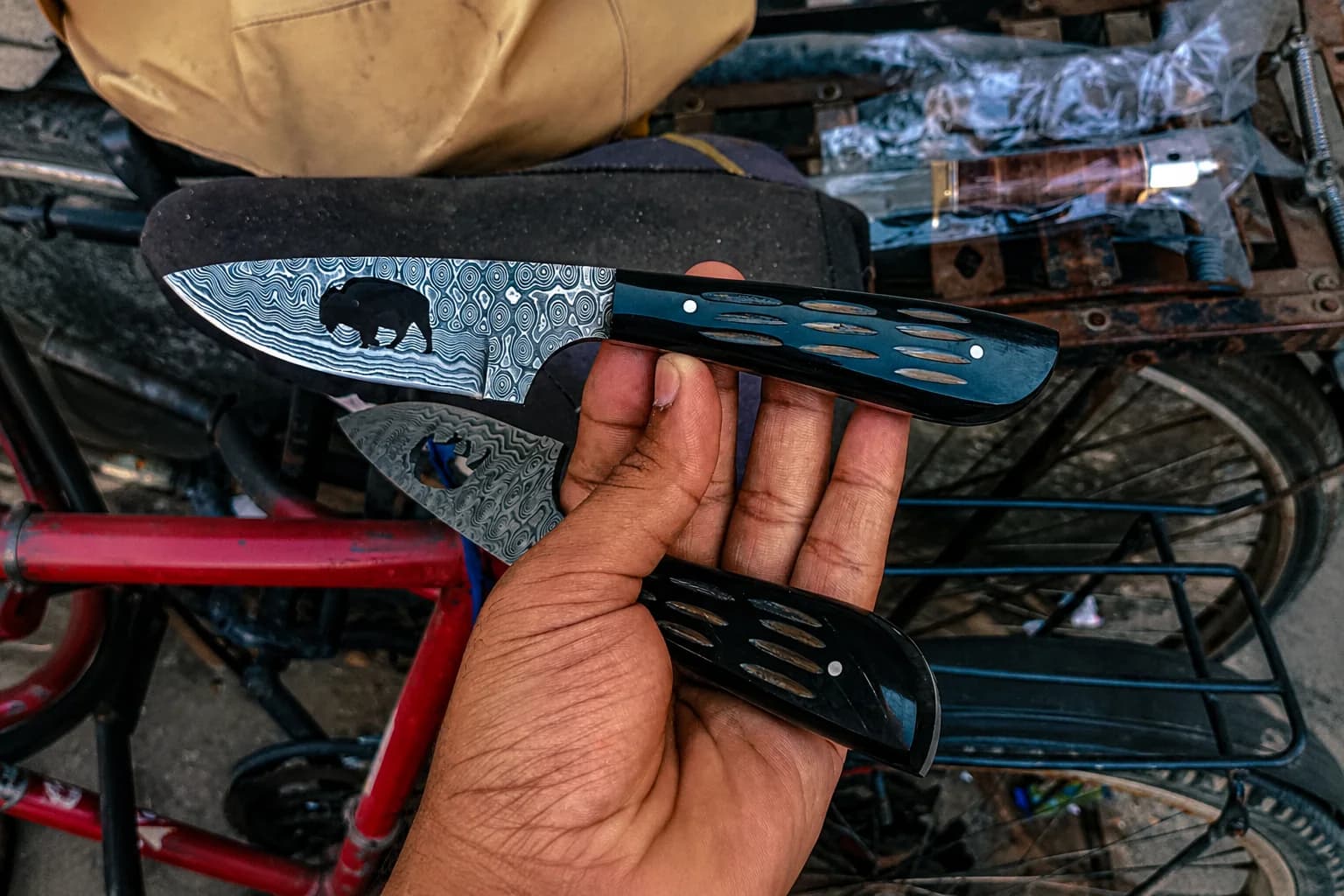
RAVEMORN is a hand-forging workshop. We make knives by hand and in small numbers — pattern-welded Damascus and D2 tool steel, fixed blades and folders, brass fittings and fitted leather sheaths. That is the whole description, and the rest of this page is what it means in practice: how steel becomes a blade, what varies from one knife to the next, and how to choose the first one you buy.
This is written from the bench rather than from a brochure, so it includes the trade-offs as well as the good parts.
WHAT DOES A HAND-FORGING WORKSHOP ACTUALLY DO?
Forging means moving steel rather than cutting it away. The steel goes into the fire until it is hot enough to move, then it is worked under the hammer — material is pushed to where the blade needs thickness and drawn out where it needs length.
What goes into the fire depends on the knife. A single-steel blade is drawn from one bar, and everything in the finished piece was in that bar when it went in. A pattern-welded Damascus blade starts differently: a stack of two different steels, plus the flux that lets them weld, and the first job of the fire and the hammer is to turn that stack into one solid billet before any blade shape exists.
Once the shape is out of the hammer the blade is ground, heat treated, ground again, and only then fitted with a handle. Every one of those stages is a judgement made by eye and hand: where the plunge line falls, how thin the edge is taken before hardening, how far the flats are polished back. A machine repeats a decision that was made once. A person makes it again on every knife.
The consequence is arithmetic rather than romance. A pair of hands finishes a certain number of knives in a week, and that number is small. When we say a run is small, it is a description of what the workshop can physically do.
WHAT DOES RAVEMORN MAKE?
The catalogue is built around knives that get used — hunting and field knives first, larger fixed blades for the heavy work, and a smaller number of pieces where the pattern or the handle material is the reason the knife exists at all.
BLADES
Two names cover the catalogue, and they are not two of a kind. Damascus describes how the steel was built: two different steels forge-welded into one billet, folded, drawn out and folded again, then etched so the layers show. D2 names what the steel is — a high-carbon, high-chromium tool steel with a reputation for edge retention, holding a working edge for a long time and asking for more patience when you finally sharpen it. Both are made as fixed blades, and there are folders too, with a locking blade and a handle scaled for a full grip.
HANDLES, FITTINGS AND SHEATHS
Handles are stabilised laminate, resin, stag and bone, or hardwood, and that is a working decision as much as a cosmetic one. Laminate and resin shrug off blood and rain and barely move with the weather. Stag, bone and hardwood are warmer in the hand and carry more character, and they want drying and a wipe of oil after a wet day.
Brass bolsters and fittings are not only trim: brass at the front of the handle puts weight behind the blade, which pulls the balance back toward your hand and takes some of the work out of a long skinning session. The leather sheath is part of the knife rather than an accessory — it decides whether the edge is protected in a pack, and whether the knife is still on your belt at the end of the day.
- Damascus fixed blades — pattern-welded, etched, and no two the same.
- D2 fixed blades — plainer steel, bought for how long the edge lasts.
- Folders with a locking blade, for the days when a sheath knife is more knife than the day needs.
- Handles in stabilised laminate, resin, stag and bone, or hardwood.
- Brass bolsters and fittings, set where they change the balance.
- Fitted leather sheaths, cut to the blade they carry.
WHY ARE NO TWO OF OUR KNIVES ALIKE?
The pattern in a Damascus blade is a record of how the billet was moved. Each fold multiplies the layers and each hammer blow bends them, and the acid etch reveals the result because the two steels darken at different rates. What you are looking at is a cross-section: the grinder cut through a stack of layers, and the pattern is where it cut.
That is why the pattern cannot be reproduced. No two billets are hammered identically, and even within a single billet the pattern changes along its length — a blade taken from one end will not match a blade taken from the other, and a deeper grind exposes different layers again.
The handles pull in the same direction. Stag, bone and hardwood are grown rather than manufactured, so grain, colour and density differ from one set of scales to the next. Between the steel and the handle, two knives of the same design come out cousins rather than copies.
IS DAMASCUS BETTER THAN D2?
Neither is an upgrade of the other, and the usual framing — Damascus for looks, D2 for work — is wrong for a plain reason. The two words answer different questions. Damascus tells you how the bar was built. D2 tells you what the bar is made of. Damascus can be forged badly and D2 can be ground beautifully, and neither of those facts follows from the name.
Compare them where they actually differ. D2 holds an edge a long time and is stubborn to bring back, so it suits someone who sharpens their own knives and has the patience for it, and it takes a plainer finish because the steel is uniform. A Damascus blade gives you a surface that records its own making and a pattern nobody else owns. It is high-carbon steel, so it wants drying and oiling, and it will spot if it is put away wet.
The honest question is not which steel wins. It is whether you are buying a tool you will sharpen for the next twenty years or a piece you want to be the only one of. Both answers are legitimate, and the workshop makes both.
WHAT DO YOU GET WHEN YOU BUY A HAND-FORGED KNIFE?
Specific things, and it is worth being plain about them.
- A blade forged and ground by hand, with its own dimensions rather than a production tolerance.
- In Damascus, a pattern that exists on that knife and on no other.
- In D2, a plainer knife chosen for how long it stays sharp.
- A handle fitted to that tang, in a material you can choose for weather or for looks.
- Brass fittings where they shift the balance, not only where they catch the light.
- A leather sheath cut to that blade.
There is one thing worth knowing before you fall for a photograph. Because the runs are small and the patterns do not repeat, the knife in a listing is the piece rather than the model. If it goes, the next one in that design will be close, but it will not be that one.
HOW DO YOU CHOOSE YOUR FIRST RAVEMORN KNIFE?
- Start with the job, not the pattern. For most people that is one fixed blade of three to four inches with a full belly, and it will cover the majority of the work.
- Pick the steel by how you sharpen. If you maintain your own edges, D2 pays you back. If you would rather carry something unmistakably yours, take the Damascus.
- Pick the handle by the weather you work in. Wet ground and long seasons favour stabilised laminate or resin; stag, bone and hardwood are for someone who will dry and oil them.
- Buy the big knife second. A larger fixed blade is for splitting, quartering and camp work, and it is a poor skinner. Add it once the first knife has shown you what it cannot do.
- Ask before you order if a detail matters. Weight, blade length and the exact pattern differ from piece to piece, and we would rather tell you than have you guess.
That is the workshop in a line: made by hand, in small numbers, with the variation left in rather than ground out.
WHERE TO START
- Hunting knives — fixed blades for skinning, dressing and butchering
- D2 steel — plainer knives bought for edge retention
- Folding knives — pocket and EDC folders
- The full catalogue — everything currently forged and finished