
Bringing a Sword to a Renaissance Faire
RAVEMORN guides · Updated
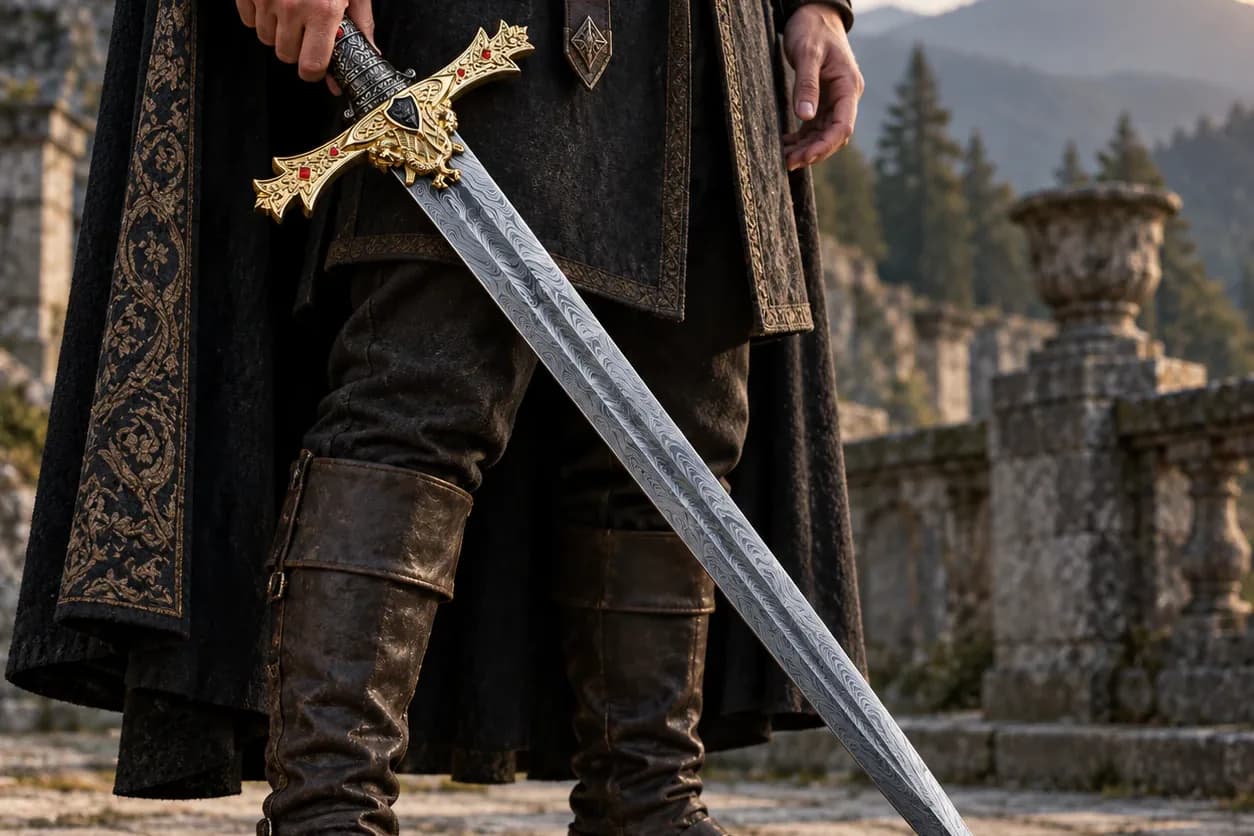
A sword at the hip finishes a Renaissance faire costume like nothing else. Most faires are happy to see them — but almost all of them have rules, and those rules differ from one event to the next. This guide explains what to expect, what peace-tying means, how to get your sword to the event, and what to ask before you go.
One thing first: this is general guidance, not legal advice. Every event sets its own policy, and the law on carrying blades differs between countries, states and cities. The event's own weapons policy, and your local law, always win.
What faires usually allow
Policies vary, but the same few rules come up again and again:
- Bladed costume weapons must stay sheathed at all times. Drawing a sword in the crowd is the fastest way to be asked to leave.
- Blades must be peace-tied — secured into the scabbard so they cannot be drawn.
- Some events check weapons at the gate and tie them for you; some ask you to arrive with them already tied.
- Some ban sharpened edges, and some ban real metal blades entirely in favour of foam, wood or resin props.
- Projectile weapons — bows with arrows, crossbows, throwing knives — are very often banned outright.
- Long weapons such as spears and polearms may be restricted in crowded areas, or allowed only for performers.
Because these differ so much, the only reliable answer is the event's own weapons policy — usually on its website under FAQs, "rules" or "costumes". If it isn't published, email the organisers before you go.
What peace-tying is
Peace-tying (or peace-bonding) means tying the sword into its scabbard so it can't be drawn by accident or in anger. The tradition is old; at a modern faire it is a simple safety measure and a signal to staff and visitors that the weapon is for show.
- Many faires provide their own ties at the gate — often a coloured cord, a zip tie or a tag — and want those used rather than your own.
- If you tie it yourself, a leather thong or a cord looped through the cross-guard and around the scabbard throat works well. It should be tight enough that the blade won't come out, and easy for staff to check.
- Never glue a blade into a scabbard or use anything that will damage the finish.
A sword needs a scabbard to be peace-tied at all, and a belt or a frog to be worn comfortably for a whole day. Our medieval arming sword and medieval longsword both come with a scabbard and a sword belt, and the Gilded Knight's longsword comes with a scabbard and a shoulder strap.
Getting it to the faire
The trip there and back is where people most often get it wrong. In many places, carrying a blade openly in public — on a train, in a car park, on the walk from the car — is treated very differently from wearing it inside an event, and in some places carrying one in public without a good reason is an offence even if it's blunt.
- Transport it covered: in a sword bag, a case, or wrapped and boxed, not worn.
- Keep it out of sight in the car, ideally in the boot or trunk.
- Put it on once you're at the event, and take it off before you leave.
- If you're travelling across a state or a border, check the rules for every place you'll pass through, not just the event's.
Conventions are stricter
Comic and fantasy conventions tend to be stricter than faires. Many ban real metal blades altogether, require every prop to pass a check at a weapons desk, and limit length. If you're cosplaying with one of our fantasy swords, read the convention's prop policy carefully — it may mean the sword stays home and appears in your photos instead.
Choosing a sword for a long day
- Think about weight and length. A sword that feels fine for five minutes can be tiring after six hours, and a long blade is awkward in crowds and queues.
- A short sword or a sword worn on a belt is easier to manage than a long two-handed piece. Our elvish short sword is light and compact.
- Match it to the costume: an arming sword for a knight, a Viking spear or axe for a Norse outfit, an ornate ceremonial sword for nobility.
- Make sure it has a scabbard you can peace-tie.
Questions to ask the organisers
- Are bladed costume weapons allowed, and are real metal blades allowed?
- Must they be peace-tied, and do you tie them at the gate?
- Is there a length limit, or a separate rule for spears and polearms?
- Are sharpened edges allowed?
- Will weapons be inspected on entry?
- Are there areas where weapons can't be carried, such as rides, taverns or children's areas?
Faire etiquette
- Never draw a weapon in a crowd, even for a photo. Ask staff whether there's a place where photos with a drawn blade are allowed.
- Let staff inspect your weapon without fuss — it's part of what keeps costume weapons welcome.
- Mind the people behind you: a sword or a spear on your back sweeps a wide arc when you turn.
Ready to choose one? See our medieval swords, Viking and historical spears and Viking axes. You must be 18 or over to order from RAVEMORN.